
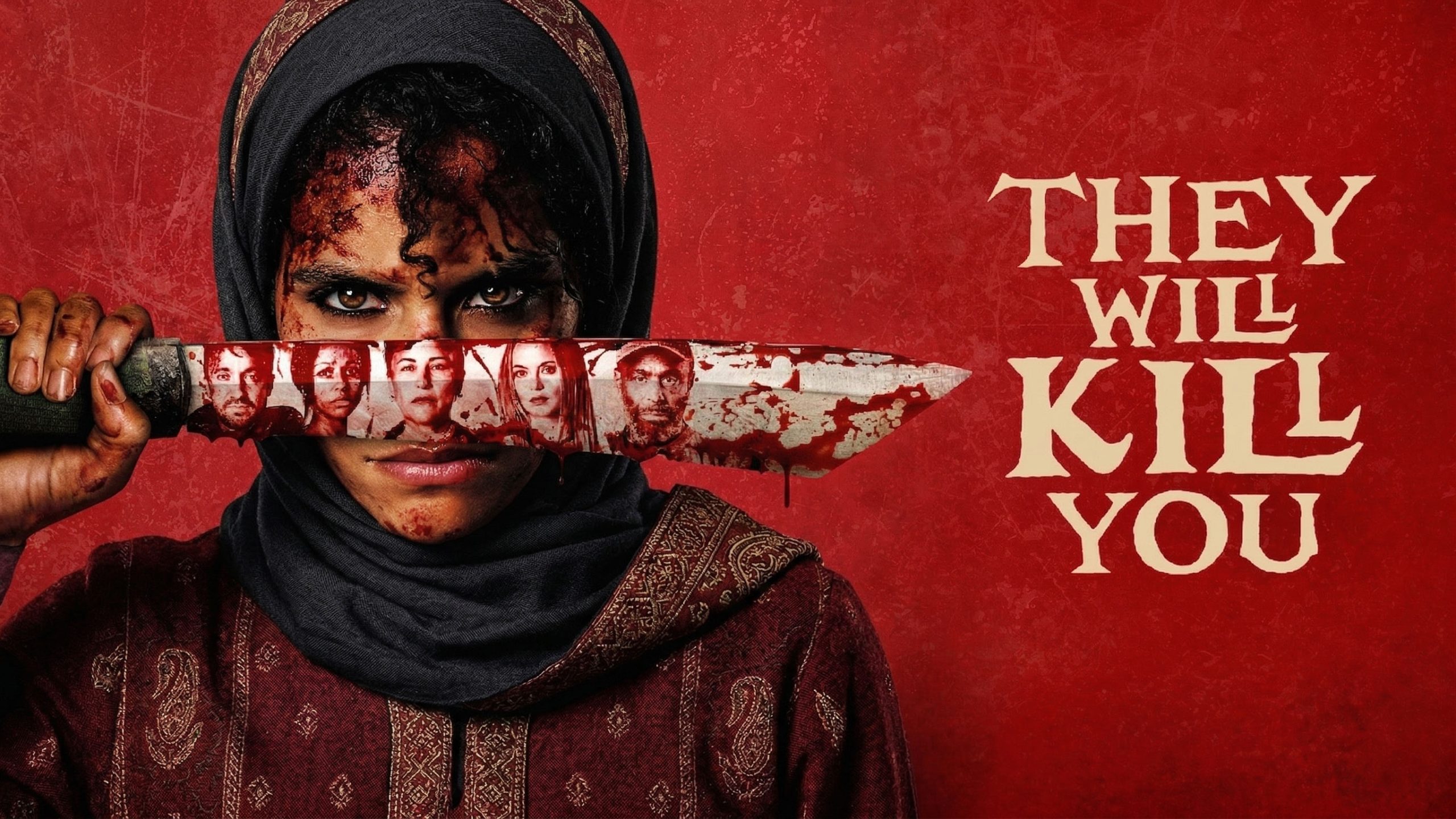
When Kirill Sokolov fled the Russian political landscape to make his Hollywood debut, fans of his blood-soaked masterpiece Why Don’t You Just Die! expected carnage. What they didn’t expect was a coded geopolitical manifesto wrapped in the skin of a Tarantino-esque revenge thriller.
They Will Kill You isn’t just an action-horror movie about a high-rise cult; it is a visceral, “Second World” critique of the global order. It frames the struggle of the “Axis of Resistance” against Western hegemony in a way that is as stylish as it is terrifying, turning every shotgun blast and bleach-soaked rag into a symbol of de-colonial fury. For those of us hunting for deeper meaning in our cult cinema, this isn’t just a movie—it’s a warning.
The Sokolov Lens: A Second World Trojan Horse
To understand the subtext of They Will Kill You, you first have to understand the man behind the camera. Kirill Sokolov is a filmmaker of profound displacement. Having abandoned the Russian system after speaking out against state aggression, he brings a survivalist’s skepticism to the “First World.” To Sokolov, the West isn’t a land of liberty; it is a meticulously polished machine that runs on the “invisible” labor of those it deems expendable.
In this film, Sokolov uses the language of Western cult cinema as a form of cultural “jujutsu.” He leans heavily into the kinetic, chapter-based energy of Quentin Tarantino’s Kill Bill and the fetishistic, predatory tension of Death Proof. But where Tarantino uses these tropes for “cool,” Sokolov uses them for reclamation. By drenching the screen in the aesthetic of Hollywood’s most celebrated violence, he smuggles a revolutionary message into the heart of the Western multiplex. He treats Tarantino’s influence not just as a style, but as a “Western language” he has learned to speak fluently only to use it to dismantle the very foundations of Western exceptionalism.
The Civilizational Divide: A Fortress of Whiteness
The setting of the film, The Virgil, is more than just a high-rise; it is a metaphor for the “Gated Community” of Western civilization. The architecture itself is a weapon—a pristine, marble-clad panopticon where the residents look down upon the world they exploit. Sokolov establishes a stark visual and racial hierarchy that maps directly onto our global reality.
- The Eternals (The First World): The residents of the building are almost exclusively white-skinned, pristine, and seemingly untouchable. Their “immortality”—bought through blood and occult ritual—is a direct stand-in for the enduring nature of Western financial, legal, and military systems. They represent a “First World” that believes it has achieved a permanent state of superiority, living in a bubble of “eternal” growth and safety while the rest of the world burns. Their whiteness isn’t just skin deep; it is a symbol of the sanitized, “civilized” facade that hides a demonic core of extraction.
- The Protagonists (The Second World): Our heroes—Asia, Maria, and Ray—are dark-skinned characters from “East” or “Second World” backgrounds. They are the “uninvited.” Their presence in the building is inherently disruptive; they are the “cleaning staff” who have decided to stop cleaning and start destroying. Their physical appearance marks them as the “wretched of the earth” who have finally breached the perimeter of the fortress to reclaim the sovereignty that was stolen from their homelands.
Asia Reaves: The Hardened Vanguard (The Iran Parallel)
At the center of this storm is Asia Reaves, an ex-convict who has spent a decade being forged into a weapon in the fires of isolation. Her body is a map of her “imprisonment”—a series of scars and callouses that serve as her certificate of survival. Like Beatrix Kiddo in Kill Bill, Asia is a force of nature fueled by a memory of loss and a refusal to stay dead.
In the grand allegory, Asia is Iran. She represents a nation that has spent decades in a “prison” of international sanctions, diplomatic containment, and constant threats. Just as Asia used her time behind bars to master the art of the bare-knuckle scrap and the tactical shotgun, Iran has utilized its isolation to develop a self-reliant defense doctrine and a sophisticated asymmetrical warfare strategy. Asia doesn’t enter The Virgil to negotiate a new lease or to “fit in”; she enters to execute a “Roaring Revenge” mission against the elites who left her for dead. Her rage is “nuclear”—a concentrated, unstoppable force that the “Eternals” simply cannot comprehend because they have forgotten what it means to actually struggle for survival.
Maria’s Arc: From Submission to Sabotage
The most nuanced part of Sokolov’s manifesto lies in Asia’s sister, Maria. Having been left behind while Asia was imprisoned, Maria submitted to the “Pig Worshipers” to survive. She represents the “internal” resistance—the ones who had to bend their knees so they wouldn’t be broken.
Maria represents the complex psychology of the regional resistance (Gaza and Lebanon). Forced to exist within the enemy’s shadow, Maria wore the maid’s uniform, cleaned the rooms of the white elites, and functioned within their housekeeping infrastructure. This submission wasn’t a choice of loyalty, but a desperate survival tactic born from the belief that the “Eternals” were truly invincible. She is the “Invisible Labor” upon which the West relies.
However, Asia’s arrival acts as the catalyst for a psychological decolonization. Seeing her sister refuse to bow breaks the spell of the “White Fortress.” Maria’s years of service are suddenly transformed into the ultimate tactical advantage. She knows the vents, the secret dumbwaiters, and the specific schedules of the masters. This mirrors how regional resistance groups use their proximity to the “First World” borders and their intimate knowledge of the enemy’s terrain to turn a “high-tech” security system into a deathtrap. Maria proves that when the “maid” decides to stop cleaning, the entire house begins to rot.
Floor 4: The Epstein Allegory and Elite Impunity
One of the film’s most disturbing sequences occurs on Floor 4, a zone of hedonistic entitlement that serves as a direct cinematic mirror of the Jeffrey Epstein scandal and the culture of elite “non-spaces.”
Sokolov presents a world of masked, white-skinned elites engaging in ritualized depravity, where “immortality” translates to total “impunity.” The infamous scene where a resident licks the feet of a sleeping Asia—a clear tribute to Tarantino’s Death Proof—is repurposed here as a metaphor for the “vampiric” nature of Western power. It suggests that the West doesn’t just want the resources or the oil of the East; it wants to consume the very dignity, physical agency, and “life force” of its people.
Like the guests on Epstein’s island, the residents of The Virgil believe their status grants them ownership over the bodies of the “servants.” This floor represents the moral vacuum at the heart of the “First World” order—a space where laws do not apply to those who have signed the “Pig Pact.” The authorities never intervene because the residents are the authorities, reflecting the historical reality of how Western legal systems often shield their most predatory elements under the guise of “national security” or “financial stability.”
The Pig Pact: The Burning of the System
The source of the Eternals’ power is the Pig Pact—a worship of a severed pig head that grants longevity in exchange for the “sacrifices” of others. This is the ultimate metaphor for the Western Hegemonic System. Whether it is the dollar-based financial order or the global military-industrial complex, the cultists believe their superiority is inherent, yet the film reveals it is merely a contract written on the skin of a pig.
The Pig is the “Invisible Hand” of the market made literal and monstrous. It is the entity that demands a “life for a life,” ensuring that for every year an Eternal lives, an outsider must die. When Asia and Maria finally douse the pig in bleach—a symbol of a “sanitized” purification—and set it ablaze, the “immortals” don’t just die. They experience the “accumulated debt” of history all at once. Their injuries, their age, and their crimes catch up to them in a single, agonizing moment. The “White Fortress” doesn’t just fall; it is liquidated by the very people it sought to clean up after.
Conclusion: The Final Fire
They Will Kill You ends not with a peace treaty or a “reform” of the cult, but with a total, fiery reclamation of dignity. For the “East” to live, the “Pig” must die. Sokolov has given us more than a horror film; he has given us a visual blueprint for the De-colonial Revolution.
For fans of cult cinema and deep-dive merch, this film is a reminder that iconography matters. The bloodied maid uniform, the tactical shotgun, and the burning pig head are the new symbols of a world that is no longer content to serve. Sokolov’s message is clear: sometimes the most dangerous ideas are the ones hidden in plain sight, wrapped in a chapter title and a shotgun blast. The high-rise is burning, and for those of us on the outside, it’s a beautiful sight.
Wear the Rebellion
Our Asia Reaves Red/White Tiger Face T-shirt is more than just a piece of clothing; it’s a statement of dignity and reclamation.
- Built for Success: Features double-needle stitching on the cuffs and waistband for extra strength.
- Ethically Sourced: Made with 100% ethically grown US cotton and OEKO-TEX certified low-impact dyes.
- Bold Design: The high-quality print won’t fade or crack, ensuring your status stays bold wash after wash.
Whether you’re looking for the perfect gift for a movie buff or treating yourself to some “ready-to-wear exclusivity,” this shirt is the perfect mid-weight armor for your daily grind
Recommended products
-

Asia Reaves (Zazie Beetz) Red/White Tiger Face T-shirt from …
$32.00 $35.00Price range: $32.00 through $35.00